
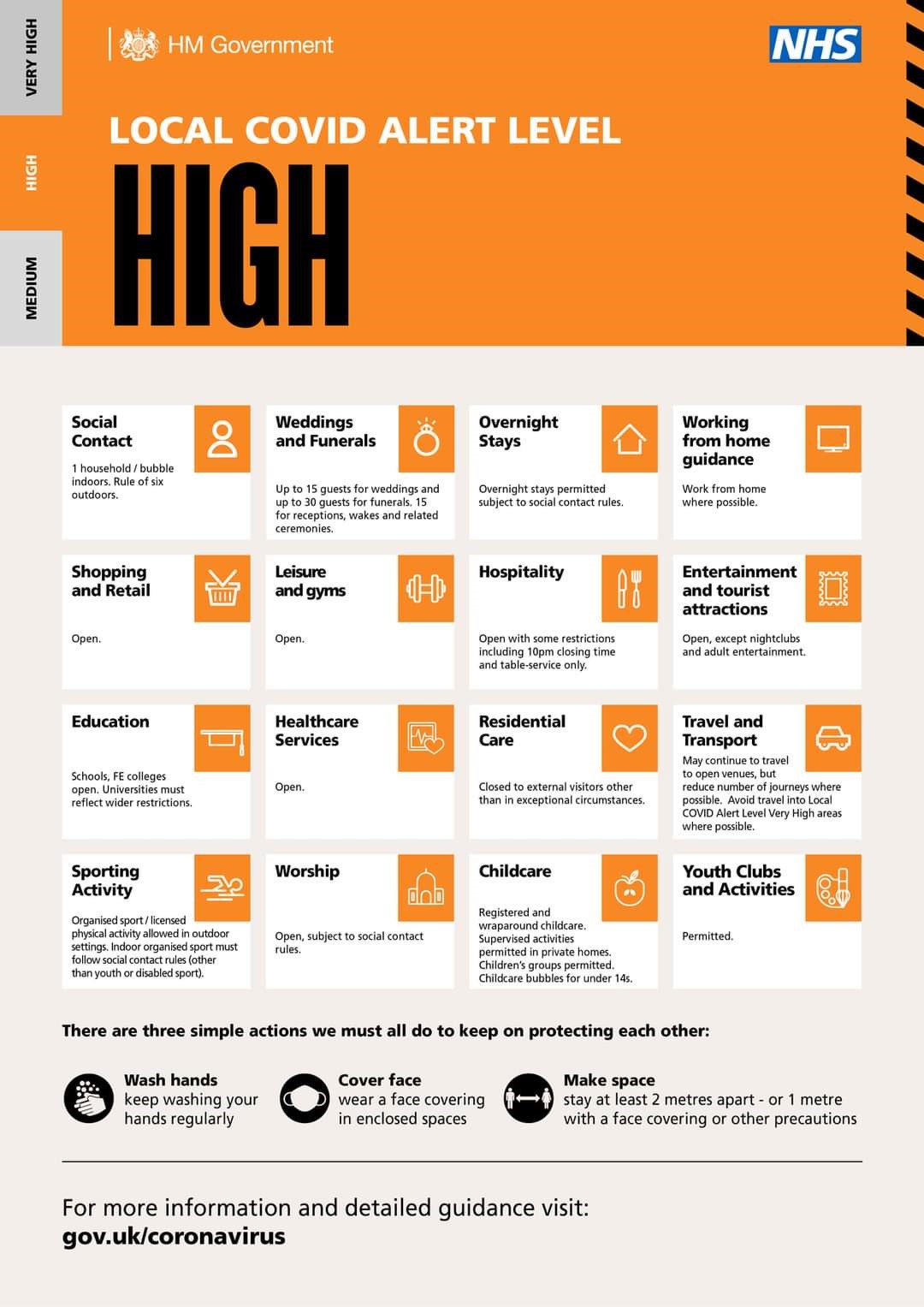
Kirklees is in Tier 2 (High): But you can still run activities & services!
***URGENT UPDATE 30/10/20 – FROM MON 2/11/20 KIRKLEES WILL BE IN TIER 3 (VERY HIGH). WE WILL LET YOU KNOW AS SOON AS WE HAVE THE FINAL DETAILS FOR WEST YORKSHIRE, BUT AT PRESENT WE THINK THAT THE TIER 2 EXEMPTIONS STILL STAND (SEE REST OF POST BELOW) & MOST THIRD SECTOR ACTIVITY WILL STILL BE ABLE TO CONTINUE***
Find out more from:
Kirklees Council
The Government

Existing Tier 2 Info & Explanations
What does this mean for your group or organisation?
Kirklees went into Tier 2 (High) of the Government’s new lockdown system from 1 minute past midnight on Wednesday 14th October. The good news is that the rules aren’t that different from the local lockdown ones that we already had in Kirklees, and so if you were already running activities or services you should still be able to continue.
If you hadn’t yet re-opened or restarted, and were unsure whether you could or not, the guidelines are now a bit clearer, plus we are now able to meet in groups of up to 6 outside, including in private gardens, which may give you some other options for how you can operate safely.
Please note:
- We all need to adhere to the Hands-Face-Space guidelines at all times
- We have had all the information in this article checked & verified by Kirklees Council’s Public Health team (and will update you if there are any changes or amendments).
- Kirklees is part of the ongoing discussions involving all 5 West Yorkshire council about whether the county should be moved into Tier 3. There is a chance that this may happen fairly soon, in which case, we will update this information as soon as we can.
- We are working with Kirklees Council to get answers to your specific questions and issues and we hope to soon have a named contact for people to speak to.
- In the meantime you can contact:
- covid-secure.enquries@kirklees.gov.uk (for businesses in need of information & advice)
- infection.control@kirklees.gov.uk (aim to reply within 48 hours)
- or get in touch with us.
- Further information can be found at:

What can we do?
- You can meet with people outside of your household or support bubble outside, including in private gardens and other outdoor spaces in groups of up to 6 (including children)
There are a number of exemptions to that allow charities and community groups to have people from different households meeting inside in groups of more than 6. In summary, you can still do volunteering and charitable services, provide education and training, run any sport or activity for children and young people, give emergency assistance and care and help to vulnerable people, organised outdoor sport, exercise and physical activity, put on indoor team sports for disabled people, and offer support, therapy and mutual aid. (And don’t forget, you can just choose to run an activity with up to 6 people maximum, so that you don’t have to worry about all the different rules and exemptions.)
Let’s look at those exemptions in a bit more detail:
- for work, volunteering to provide voluntary or charitable services
- for example, you can still volunteer at a charity shop or a food bank & the Government’s own information on volunteering confirms that (as long as you are adhering to the Covid-safe measures for that venue or workplace):
-
In all three local COVID alert levels, while you are volunteering:
- You can meet in groups of any size from different households, indoors or outdoors.
- You can travel within and between different local COVID alert levels.
- Find out more
- It’s also worth noting that if you are sticking to the ‘Rule of 6’ for any reason, people who are working, are not included in the 6. So for example, if you are facilitating a session or activity with a paid worker, you can have 6 plus them.
- for registered childcare, education or training
- for example, all schools, nurseries and colleges are open and are adhering to their own Covid-safe procedures.
- This exemption also applies to community learning activities and we know of groups who are running activities such as cookery classes and sewing classes – with smaller groups of up to 6 and each person working at a separate table, and with restrictions on sharing equipment and some activities. Teachers may be demonstrating some skills in class and giving learners the information and resources to take away and try for themselves at home.
- for supervised activities provided for children, including wraparound care (before and after school childcare), youth groups and activities, and children’s playgroups
- Community-based nurseries, playgroups and parent and toddler groups also come into this category and can operate with Covid-safe measures. For example, LS2Y have been running an outdoor parent and toddler group.
- Scouts and Guide groups are still running and are adhering to rules and guidelines set out by their national governing bodies.
- to provide emergency assistance, and to avoid injury or illness, or to escape a risk of harm
- to provide care or assistance to someone vulnerable
- both of the above may apply if you’re providing crisis or emergency care or support, health or social care services, or mental health support.
- for outdoor exercise and dance classes, organised outdoor sport, and licensed outdoor physical activity
- If the activity you provide is covered by a national governing body (such as the Rugby Football League, the FA or England Netball) then they will have their own rules and guidelines that you must adhere to.
- Please note that this exemption is for outdoor sport and exercise only. Indoor exercise classes and organised sport will only be permitted if people avoid mixing with those outside their household or support bubble. (For example, yoga.)
- Spectators are allowed as long as people adhere to social distancing and the Rule of 6 (i.e. you have have lots of groups of up to 6, but they all need to be spread out) and you must have a Test and Trace system in place.
- Yorkshire Sport/Sport Leeds recently hosted a webinar on Making Sport Happen in Covid Environment
- Advice and support from Yorkshire Sport for those delivering sports and physical activities
- Support for sports clubs from Club Matters –
- CIMSPA – guidance for coaches and facilities on reopening
- If you have further questions, you can contact Andy Cook from the Sport and Physical Activity Development Team at Kirklees Council – andy.cook@kirklees.gov.uk or Julie Smith, Development Manager for Yorkshire Sport Foundation – Julie.smith@yorkshiresport.org
- indoor organised team sports for disabled people, and youth sport
- Indoor sports for disabled people, educations sport and supervised sports and physical activity for under-18s is allowed with more than 6 people.
- Please note that indoor team sports for able-bodied adults now have to adhere to the ‘Rule of 6’ and you have to make sure that people aren’t mixing and socialising outside of their households.
- Again, it’s worth checking with your sport’s governing body, if you have one (for example, British Gymnastics, Basketball England or British Dodgeball).
- support groups of up to 15 participants – formally organised groups to provide mutual aid, therapy or any other form of support (not to take place in private dwellings)
- This exemption potentially covers most community activities, for example:
- mental health support group and activities
- wellbeing support and activities
- specialist support services (for example addiction support, cancer support, dementia support)
- emergency Covid19 community support activities and mutual aid groups
- activities that reduce loneliness and isolations, including ‘social’ activities like knit and natter
- Some of the groups that we know are running these sorts of groups are:
- S2R are running their allotment group, and have restarted their growing group, work day group and some of their face-to-face art and craft groups
- Denby Dale Men’s Shed
- Andy’s Man Club
- Platform 1
- Meditation group at Marsden Mechanics
- Most are still sticking to a maximum of 6 people (or less depending on the space and their own risk assessment), some are doing a mixture of online/remote services and groups, and face to face ones. Some are putting on several sessions to accommodate more people.
- This exemption potentially covers most community activities, for example:
What Else Do I Need to Consider?
- You have to do your own risk assessment for the activity and the space
- If you are using a community venue, they can say whether they think it’s safe for their space to be used for a particular activity and can say no or stay closed if they think that they can’t follow the advice and make the building Covid-secure.
- Each community building is responsible of for managing the risks for using that building and will have to have done a Covid-19 Risk Assessment, on top of any risk assessments that they already have in place for using their venue. this will decide the maximum number of people that can be in a particular space safely and whilst social distancing. Find out more.
- You have to adhere to Covid-safe measures and guidelines for volunteers and participants (as well as workers), including following social distancing rules, avoiding public transport and busy times, wearing masks, or displaying a Track and Trace QR code as appropriate.
- You have to make sure that people are not mixing and socialising.
- You have to make sure that people aren’t sharing tools and equipment.
- People should be working from home if possible, and this applies to volunteers too.
- If you are running any sort of activity inside, can you improve ventilation by having window or doors open (as schools and offices are being advised to do)? Even just having them ajar will help air to circulate and reduce transmission of the virus. Find out more.
- People who are clinically extremely vulnerable and/or were shielding should take additional precautions to protect themselves, including:
- Strictly sticking to the ‘hands, face, space’ guidance
- Keeping their social interactions to a minimum
- Meeting people outdoors or in a well-ventilated area wherever possible
- Working from home if possible, and if that’s not possible, extra measures may have to be in place to make sure they they are safe in a workplace (which includes volunteering)
- Travelling and shopping outside of peak hours and avoiding/limiting journeys on public transport
- Find out more
Other Useful Info
- It is now a legal requirement for people to self-isolate if they test positive for Covid19 or have been in contact with someone who has tested positive, and they can be fined up to £10,000. Kirklees Council can now give people a Test and Trace Support Payment of £500 if they will lose income by self-isolating. Find out more
- There is now a ‘walk-through’ testing centre in central Huddersfield, as well as one’s at Earlsheaton and Ravensthorpe, plus ‘drive-through’ testing centres in Batley, Dewsbury, Holmfirth (this may be moving to Meltham shortly) and Fartown. You must book before going for a test. Find out more
- National guidance for safe use of multi-purpose community facilities
- Working safely during coronavirus
- New Covid19 Job Support Scheme
- Find out about the Test and Trace App and how to get a QR code for your venue.
- Find out how to report and outbreak at your group or organisation, and keep young people safe online during the pandemic